



RAID and its Types
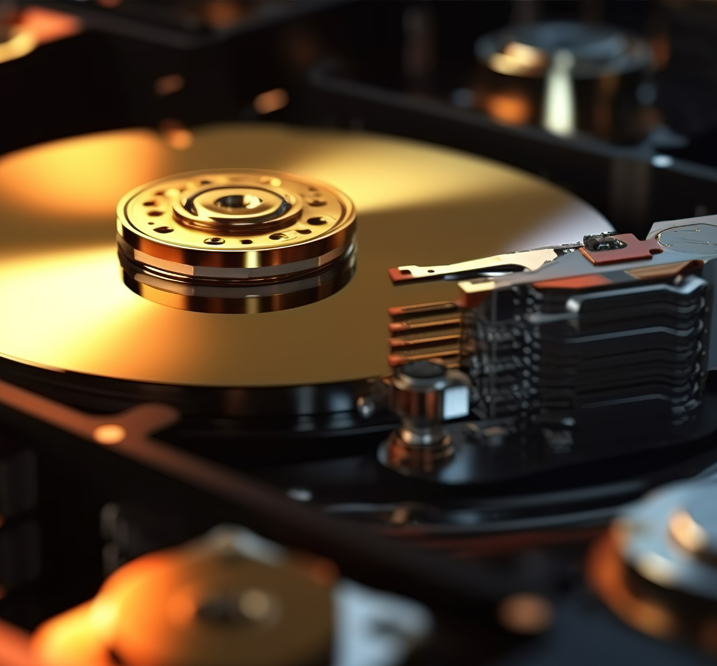
RAID (Redundant Array of Independent Disks) is a data storage technology that combines multiple physical hard disk drives (HDDs) or solid-state drives (SSDs) into a single logical storage unit.
The primary objectives of RAID are to improve storage performance, increase data availability, provide fault tolerance, or achieve a combination of these benefits.
RAID is widely used in:
- Enterprise servers.
- Database management systems.
- Data centers.
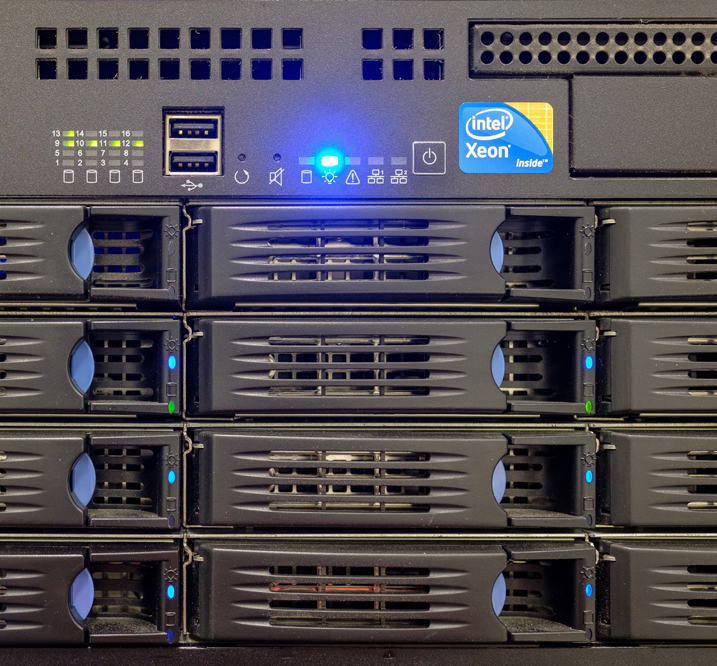
- Network Attached Storage (NAS).
- Virtualization environments.
- Business-critical applications.
RAID distributes or duplicates data across multiple physical disks using different techniques.
The three fundamental techniques are:
- Striping: Dividing data into blocks and distributing them across multiple disks to improve performance.
- Mirroring: Writing identical copies of data to multiple disks to provide redundancy.
- Parity: Storing additional mathematical information that allows lost data to be reconstructed if a disk fails.
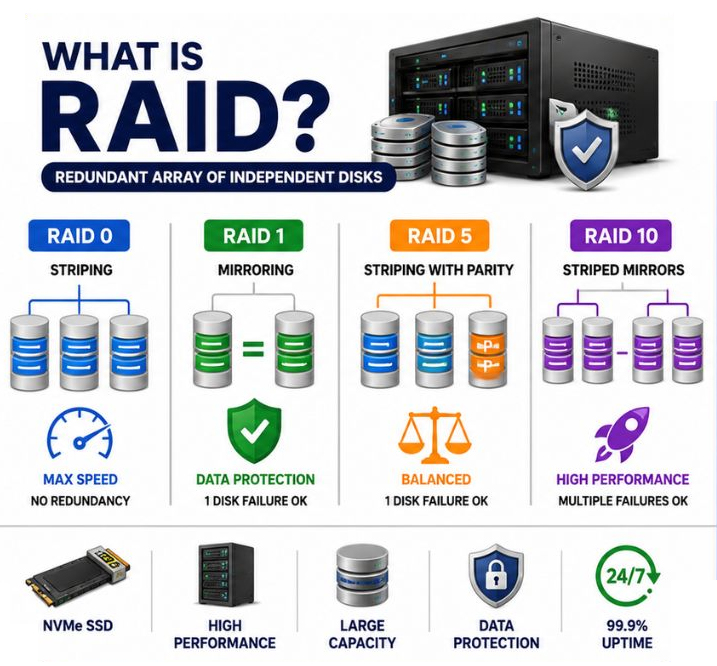
RAID 0 – Striping
RAID 0 divides data across two or more drives. It provides high speed and maximum usable capacity, but it has no fault tolerance. If one drive fails, the entire array may be lost. Best for: High-performance tasks and temporary data.
RAID 1 – Mirroring
RAID 1 stores identical copies of data on two or more drives. If one drive fails, another copy remains available. However, only about half of the total capacity is usable in a standard two-drive configuration.
Best for: Important data and small servers.
RAID 5 – Striping with Parity
RAID 5 requires at least three drives. It distributes data and parity across the drives and can tolerate one drive failure. It offers a good balance between performance, storage capacity, and redundancy.
Best for: NAS systems and general-purpose servers.
RAID 6 – Double Parity
RAID 6 requires at least four drives and uses two sets of parity information. It can tolerate two drive failures, providing greater protection than RAID 5.
Best for: Large storage systems and important data.
RAID 10 – Mirroring + Striping
RAID 10 combines RAID 1 and RAID 0. It provides high performance and redundancy but typically uses only 50% of the total raw capacity.